What Is SSDP? A Complete Guide to the Super Sensory Development Program for Children
Every child sees, learns, remembers, observes, and responds to the world differently.
Some children learn quickly through visuals. Others respond better to sound, movement, interaction, repetition, or hands-on experiences.
The Super Sensory Development Program (SSDP) is designed to provide children with structured experiential activities that encourage them to explore their attention, observation, sensory awareness, memory, creativity, confidence, and learning abilities.
At Rajyog Agnihotra Global Foundation, our approach focuses on providing children with a positive environment where learning becomes an experience rather than simply another academic task.
What Is the Super Sensory Development Program (SSDP)?
The Super Sensory Development Program, commonly known as SSDP, is an activity-based developmental program primarily designed for children between 5 and 16 years of age.
The program includes exercises and activities involving areas such as:
Concentration
Observation
Sensory awareness
Memory
Listening
Creativity
Visualization
Mindfulness
Confidence
Coordination
Problem-solving
Decision-making
Rather than focusing only on academic performance, SSDP takes a broader approach toward children's learning and personal development.
Why Is Sensory Development Important for Children?
Children continuously receive information through their senses.
They observe colours and shapes, listen to sounds and instructions, recognize patterns, experience textures, coordinate movement, remember information, and respond to their surroundings.
Structured sensory activities can encourage children to pay closer attention to these experiences.
This makes sensory-based learning an interesting complement to conventional education when activities are age-appropriate, safe, and properly guided.
Who Can Participate in SSDP?
Our Super Sensory Development Program is designed primarily for children aged 5–16 years.
Activities can be adapted according to the child's age and level of understanding.
The program may be suitable for parents looking to provide their children with additional opportunities to explore:
Concentration • Observation • Memory • Creativity • Confidence • Mindfulness • Sensory Awareness • Communication
SSDP is not intended to replace school education. Instead, it provides an additional experiential environment where children can participate in structured developmental activities.
What Happens During an SSDP Session?
SSDP sessions can include a combination of individual and group activities.
Depending on the program structure and the child's age, activities may involve:
Observation exercises
Memory activities
Colour recognition
Listening exercises
Creative activities
Visualization
Mindfulness exercises
Coordination activities
Pattern recognition
Communication exercises
Confidence-building activities
Games requiring concentration and attention
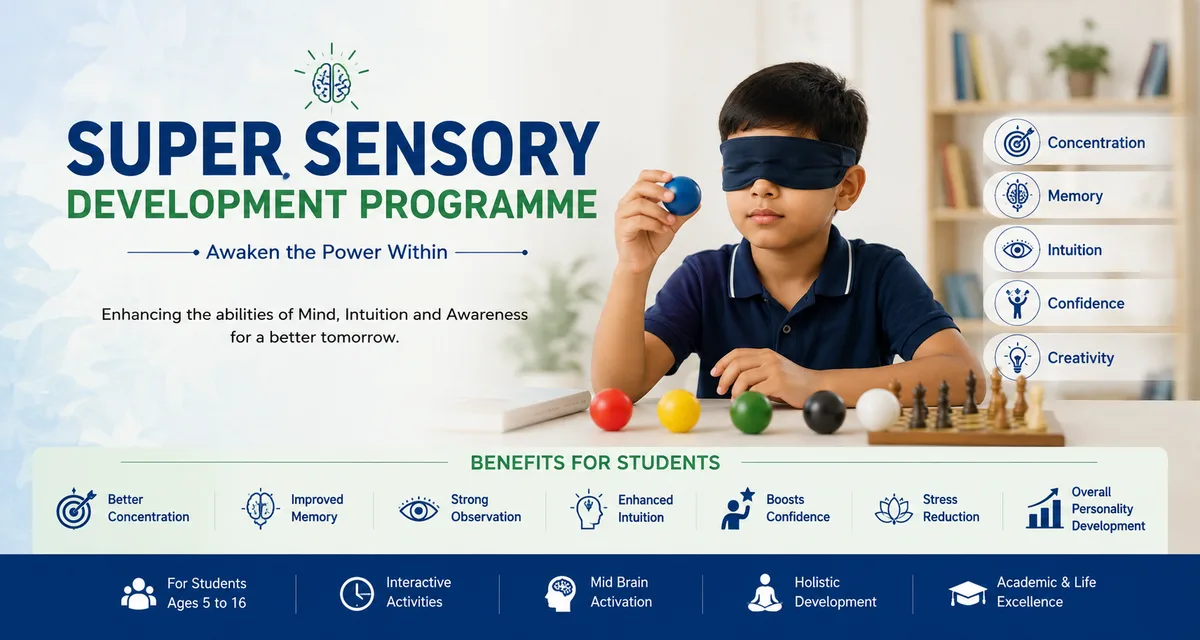
Some demonstrations may also involve blindfold-based sensory activities under trained supervision.
The emphasis should remain on participation, learning, exploration, and enjoyment rather than competition between children.
Key Areas Explored Through SSDP
1. Concentration & Attention
Children today grow up surrounded by television, smartphones, gaming, social media, notifications, and other digital stimulation.
SSDP includes structured activities requiring children to remain attentive to a particular instruction, object, sound, pattern, or task.
Regular participation in attention-based exercises can provide children with opportunities to practice staying engaged with an activity.
2. Memory
Memory plays an important role in everyday learning.
Children may participate in exercises involving sequences, objects, patterns, instructions, colours, words, or other age-appropriate information.
The purpose is to make memory practice interactive and enjoyable.
3. Observation Skills
There is a difference between simply looking at something and observing it carefully.
Observation-based exercises encourage children to notice details, identify differences, recognize patterns, and pay greater attention to their surroundings.
4. Sensory Awareness
SSDP activities may involve different sensory inputs, helping children become more conscious of what they see, hear, touch, and experience.
The objective is not to promise extraordinary abilities but to encourage greater awareness and engagement with sensory information.
5. Creativity & Imagination
Children naturally possess imagination.
Creative exercises can give them opportunities to express ideas, visualize possibilities, experiment, and think beyond fixed answers.
Drawing, visualization, storytelling, patterns, puzzles, and other creative activities may form part of this approach.
6. Listening Skills
Listening is essential both inside and outside the classroom.
Activities requiring children to follow verbal instructions, recognize sounds, remember sequences, or respond carefully can provide opportunities to practise active listening.
7. Confidence
Confidence often develops through experience.
When children successfully complete age-appropriate activities, participate in demonstrations, communicate with others, and gradually attempt unfamiliar tasks, they may develop greater confidence in participating and expressing themselves.
8. Mindfulness
Learning how to become calm and attentive can be valuable for children.
Simple mindfulness, breathing, visualization, or quiet-awareness exercises may be incorporated into the program to introduce children to conscious attention in an age-appropriate manner.
What Are Blindfold Activities in SSDP?
Blindfold demonstrations are among the activities that often generate the most curiosity about sensory-development program.
Under appropriate supervision, certain exercises may be conducted while a child's normal visual input is restricted.
Depending on the activity and training approach, demonstrations may include exercises related to:
Object recognition
Colour-related activities
Movement and coordination
Sensory discrimination
Memory tasks
Listening activities
Such activities should always be conducted safely and under trained adult supervision.
Importantly, extraordinary claims sometimes associated online with “midbrain activation,” blindfold reading, ESP, or similar abilities are not established by mainstream scientific evidence.
At Rajyog Agnihotra Global Foundation, these activities should therefore be understood as experiential training or demonstrations rather than proof that a child has developed scientifically verified supernatural abilities.
SSDP and Academic Development
One common question from parents is:
“Will SSDP improve my child's marks?”
No responsible developmental program should guarantee academic results.
Academic performance depends on many factors, including teaching quality, study habits, understanding of subjects, sleep, nutrition, emotional well-being, home environment, practice, motivation, and individual learning differences.
However, skills such as attention, organization, observation, listening, confidence, and disciplined practice can be useful within a child's broader learning journey.
SSDP therefore focuses on developmental experiences rather than promising particular examination scores.
SSDP in Today's Digital World
Today's children are growing up in an environment very different from previous generations.
Digital technology offers tremendous opportunities for education and communication, but children also experience increasing competition for their attention.
Phones, games, videos, social media, streaming platforms, and rapid digital content can occupy significant portions of their day.
This makes offline activities involving observation, creativity, physical interaction, mindfulness, communication, and focused participation particularly valuable.
SSDP creates a structured space where children can temporarily move away from passive screen consumption and actively participate in learning experiences.
Role of Parents in a Child's Development
Parents remain one of the most important influences in a child's development.
A program can provide activities and guidance, but development continues every day at home.
Parents can support children by:
Encouraging curiosity
Appreciating effort rather than only results
Providing healthy routines
Creating reasonable screen boundaries
Encouraging reading and creativity
Giving children opportunities to solve problems
Listening to their thoughts
Avoiding unnecessary comparison
Supporting adequate sleep and physical activity
Spending meaningful time together
Most importantly, every child develops differently.
Children should not be compared simply because one child performs a particular activity faster than another.
Why Choose a Structured SSDP Program?
A structured program provides children with progressive activities rather than random exercises.
It also helps parents understand the objective behind different activities.
At Rajyog Agnihotra Global Foundation, we aim to create a supportive learning environment built around:
Exploration instead of pressure.
Participation instead of comparison.
Confidence instead of fear of failure.
Development instead of unrealistic promises.
SSDP for Schools and Educational Institutions
The principles behind sensory awareness, mindfulness, observation, concentration, creativity, and experiential learning can also be introduced through school awareness programs and workshops.
Educational institutions may organize age-appropriate sessions introducing students to selected developmental activities.
Such programs can complement—not replace—formal education and professional educational support.
Our Approach at Rajyog Agnihotra Global Foundation
At Rajyog Agnihotra Global Foundation, we believe that education should help children develop beyond textbooks.
Our initiatives aim to encourage greater awareness around:
Mindfulness • Concentration • Observation • Creativity • Confidence • Values • Conscious Living • Holistic Development
Through structured programs, workshops, demonstrations, and educational initiatives, we aim to create meaningful learning experiences for children and families.
Give Your Child an Opportunity to Explore
Every child has a unique combination of abilities, interests, strengths, and ways of learning.
The objective should not be to turn every child into the same kind of performer.
It should be to provide them with opportunities to explore, learn, observe, create, participate, and grow with confidence.
The Super Sensory Development Program (SSDP) provides one such experiential platform.
If you would like to understand SSDP, attend a demonstration, organize an awareness session, or explore the program for your child, school, or educational institution, connect with Rajyog Agnihotra Global Foundation.
Observe More. Focus Better. Explore Potential. Grow With Confidence.
Visit: www.rajyogagnihotraglobal.org
Disclaimer: SSDP is an educational and developmental program and does not diagnose, treat, cure, or prevent medical, psychological, neurological, learning, or developmental conditions. Individual experiences and outcomes may vary. Activities described as sensory, blindfold, intuition, midbrain, or similar exercises should not be interpreted as scientifically established evidence of paranormal or supernatural abilities.